
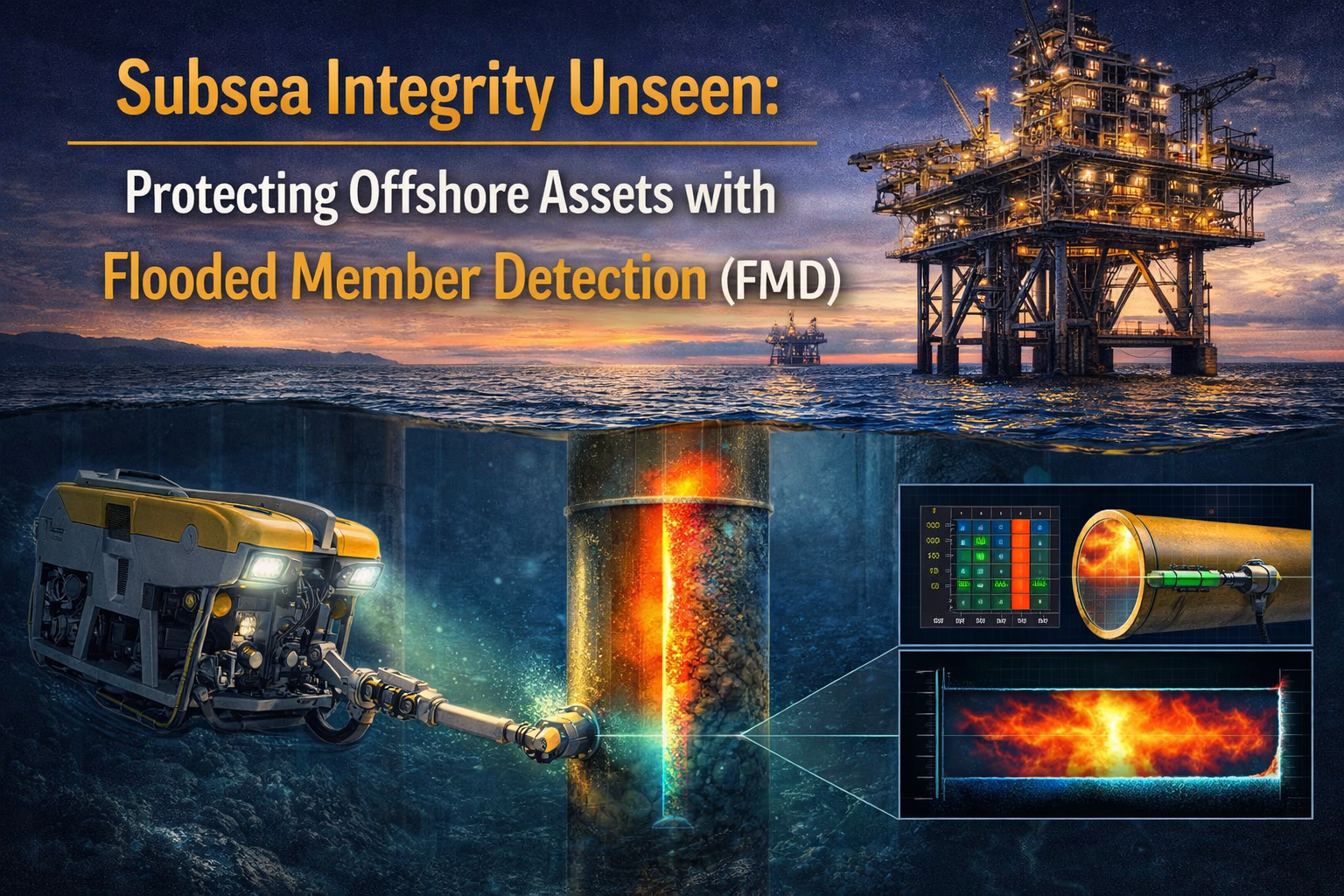
Subsea Integrity Unseen: Protecting Offshore Assets with Flooded Member Detection (FMD)
Introduction: The Hidden Risk Beneath Offshore Structures
Offshore platforms operate in one of the most demanding environments in the world. Constant wave loading, corrosion, fatigue stress, and extreme weather conditions put continuous pressure on subsea structures—especially platform jackets and structural members that remain underwater for decades.
What makes the challenge even more critical is this: most structural damage happens where it cannot be seen.
Water ingress inside structural members can silently weaken an offshore platform long before visible signs appear. That’s why Flooded Member Detection (FMD) has become one of the most important tools in modern offshore asset management.
What Is Flooded Member Detection (FMD)?
Flooded Member Detection (FMD), also known as Flooded Member Inspection (FMI), is a non-invasive inspection technique used to determine whether structural members in offshore platforms—such as tubular braces and legs—have been compromised by water ingress.
These structural members are designed to remain sealed and dry internally. When water enters due to cracks, corrosion, or weld failures, the structural strength of the member can decrease significantly. Over time, this can lead to fatigue damage, instability, or even catastrophic structural failure.
FMD allows engineers to detect internal flooding without cutting, opening, or shutting down the structure. This makes it one of the safest and most efficient inspection methods for offshore operations.
Why Internal Flooding Is a Serious Structural Risk
At first glance, a platform jacket may look perfectly intact from the outside. However, internal flooding changes the structural behavior of steel members in several dangerous ways:
- Loss of structural strength due to internal corrosion
- Increased weight and stress caused by trapped water
- Accelerated fatigue damage under constant wave loading
- Reduced load-bearing capacity in critical structural components
Because offshore platforms are designed with precise load calculations, even a small loss of strength in one structural member can affect the stability of the entire structure.
This is why early detection is not just important—it is essential.
How Flooded Member Detection Works
Flooded Member Detection uses advanced non-invasive inspection techniques to determine whether water is present inside subsea structural members.
Instead of relying on visual inspection alone, engineers can analyze the internal condition of structural members using diagnostic tools that detect density differences between air-filled and water-filled structures.
This allows inspection teams to:
- Identify exactly which members are flooded
- Locate internal structural weaknesses
- Assess the severity of damage
- Plan targeted repairs instead of large-scale structural work
Most importantly, all of this can be done without interrupting offshore production.
The Importance of FMD for Offshore Platform Jackets
Offshore platform jackets are complex structural frameworks designed to withstand extreme environmental conditions for decades. However, once a member becomes flooded, its long-term reliability becomes uncertain.
Flooded Member Detection helps operators:
- Prevent Catastrophic Structural Failures
By detecting internal flooding early, operators can repair or reinforce damaged members before they compromise the structural integrity of the platform.
- Improve Long-Term Structural Health
FMD provides accurate data about the condition of subsea structures, allowing companies to make smarter long-term maintenance decisions.
- Reduce Inspection Uncertainty
Instead of relying only on diver-based visual inspection, operators gain precise diagnostic data about what’s happening inside the structure.
Supporting Regulatory Compliance and Safety Standards
Offshore operations are heavily regulated, especially when it comes to structural integrity and safety. Regulatory authorities require regular inspection and verification of subsea structures to ensure they remain safe for long-term operation.
Flooded Member Detection plays a key role in helping companies meet these requirements by:
- Providing reliable inspection data
- Supporting structural integrity assessments
- Reducing safety risks for inspection teams
- Demonstrating compliance with offshore safety standards
By using FMD, operators can not only improve safety but also strengthen their regulatory compliance strategy.
Why Non-Invasive Inspection Is the Future of Offshore Integrity
Traditional inspection methods often required significant operational disruptions. In contrast, non-invasive inspection technologies like Flooded Member Detection allow operators to assess structural health while the platform remains fully operational.
This approach delivers multiple advantages:
- No production shutdowns
- Lower inspection costs
- Faster diagnostics
- Better long-term asset management
- Reduced operational risks
As offshore assets continue to age, these advanced inspection methods will become even more critical.
Beyond Inspection: A Data-Driven Approach to Asset Protection
Flooded Member Detection is not just about identifying damage—it’s about making smarter decisions. With accurate structural data, operators can move from reactive maintenance to predictive asset management.
Instead of waiting for visible damage, companies can detect hidden risks early, prioritize repairs effectively, and extend the life of offshore infrastructure.
Conclusion
The most dangerous threats to offshore platforms are often the ones that remain hidden beneath the surface. Flooded Member Detection provides a powerful solution by allowing operators to detect internal flooding, protect structural integrity, and ensure long-term safety without disrupting production.
In an industry where safety, reliability, and compliance are critical, FMD is no longer optional—it is an essential part of modern offshore asset management.